Paleontology and Geology of The White River Fm.
Geology of the White River Formation:
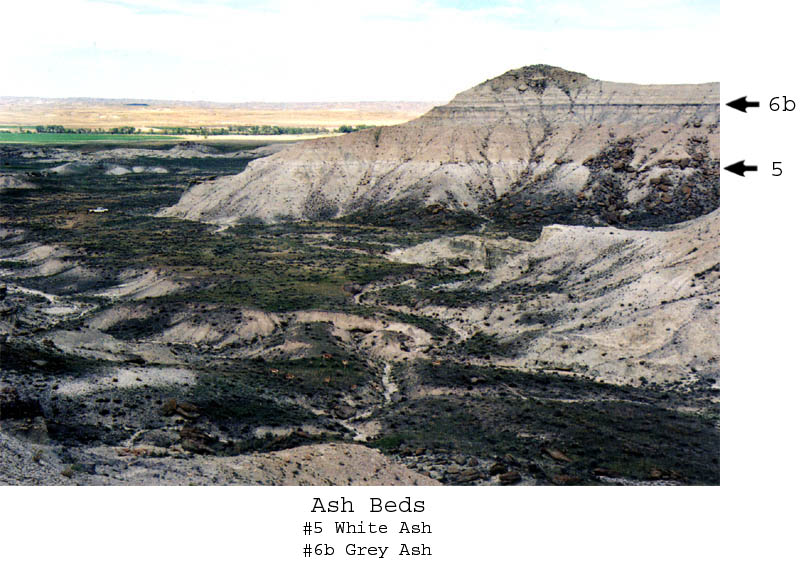
 The White River Formation contains numerous late Eocene and Oligocene vertebrate, invertebrate and plant fossils in the Douglas, Wyoming area. It is composed of terrestrial sedimentary rocks (300 meters thick), including mudstones, siltstones, sandstones, minor conglomerates, and volcanic tuffs.The paleoenvironment was an aggradational meandering river system (ancestoral North Platte River) with the conglomerates and sandstones reflecting the stream channels and mudstones and siltstones deposited during periodic overbank flooding by the river.
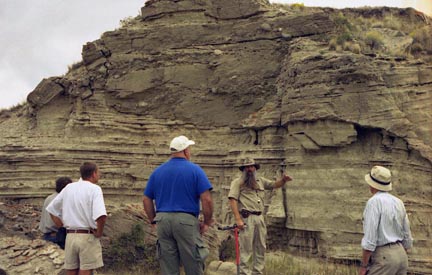 It is a classic paleoenvironment for preserving a terrestrial fauna. The occurrence of more than 13 volcanic tuffs (airfall ash deposits) within the White River Formation interspersed with numerous excellent fossils and magnetically susceptible rocks provides a unique and scientifically exciting control to the geology of this area that is unparalleled. Only two of the tuffs has been isotopically dated (Tuff #5 age 33.9 Ma, Swisher and Prothero, 1990 and Prothero and Swisher, 1992)(Tuff #5 age 34 Ma, Tuff #7 age 31.2 Ma, J. Scott 2000), but many of the other tuffs can and should be dated. The stratigraphy and invertebrate (snail) paleontology of the area has recently been thoroughly studied by Evanoff (1993 and et.al 1992) with many measured sections and descriptions of the volcanic tuffs. A generalized measured section is presented here from Evanoff's PhD dissertation studies( Figure 2). This co-occurrence of fossils, magnetically stable beds, and datable volcanic tuffs will allow future research in this area to be correlated regionally (Nebraska, South Dakota, western U. S.) and worldwide.
Vertebrate Paleontology of White River Formation:
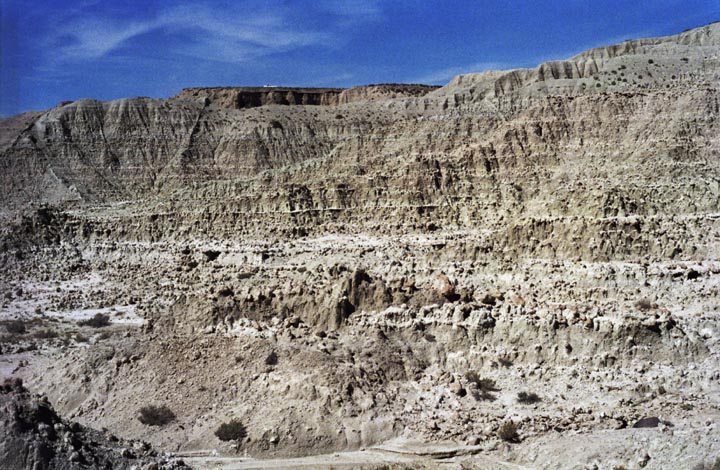
The vertebrate fossils from the Douglas area include spectacular specimens of reptiles (snakes, lizards, tortoises and turtles) and mammals (ancestoral modern lineages: horses, dogs, cats, mustelids, camels, deer, rhinoceros, rodents, rabbits, insectivores, and marsupials and extinct lineages: brontotheres, entelodonts, oreodonts, hyaenodonts, and sabertooth cats). It is the world's best locality for many of the small, delicate, and rare mammals and reptiles of the mid-Tertiary period. The specimens of fossil snakes (Breithaupt, 1997), amphisbaenids (Dickson and Cunningham, 1997), marsupials, insectivores, and rodents are unique and exceptional. This is due to a combination of paleoecology (a burrowing community)(Sundell, K, 1997a and Sundell, C., 1998) and unique preservation conditions (secondary calcite cementation). Well articulated skeletons of many of the larger mammals are also found. Many include unborn fetuses (Figure 3), juveniles, and multiple death assemblages that are unknown scientifically (Sundell, K., 1997a,1997b, 1998).
Several local vertebrate and one invertebrate paleontological studies have been done in this area that provide a general biostratigraphic framework (Kron, 1978, Prothero, 1983, and Evanoff, 1993, Evanoff, et. al. 1992). The White River Formation can usually be subdivided into three fossil land mammal ages based on the vertebrate fauna, including the Chadronian, Orellan, and Whitneyan North American Land Mammal Ages (NALMAs) from oldest to youngest, respectively. (Figure 4. White River Formation simplified chart). The Chadronian and Orellan faunas have been firmly delineated in the Douglas area, but the Whitneyan fossils are rare in the upper third of the White River Formation at this locality and elsewhere. The change from Chadronian to Orellan faunas occurs very near the one isotopically dated tuff bed. This single date and faunal change has been a key data point for revisions of the Chadronian North American land mammal age from the early Oligocene epoch to the late Eocene epoch (Swisher and Prothero, 1990, Prothero and Swisher, 1992). This important boundary change and the less studied Orellan to Whitneyan boundary can be studied in great detail in the Douglas area. A second key tuff bed has been located slightly above the probable Orellan/ Whitneyan NALMA boundary and tentatively dated at ~31 MA (Scott 2000) with more than 120 meters of Whitneyan fossiliferous rocks occurring above this tuff. The unique interrelations of prolific fossils, radiometric datable tuff beds, and paleomagnetic susceptible sediments from three NALMAs and 5 magnetic Chrons ((9-13) in one geographic location is the primary focus of future research at this locality.
Paleoecologic significance:
By studying the precise stratigraphic and geographic location of the more than 3,500 skulls and skeletons collected by Douglas Fossils a tremendous data set can be used to help interpret paleoecological changes both vertically (stratigraphic relations to ash beds and evolutionary change through time) and horizontally (geographic lateral changes in the Douglas area and correlations to other White River outcrops in Nebraska, South Dakota, and Colorado). Additionally the forensic analysis of some of the more  spectacular specimens (multiple oreodonts, multiple camels, carnivore dens, carnivore killsites, bite marks, coprolites, and leftovers) allows us to better interpret how each of these unique organisms lived their lives and how they died. We have studied in detail and proven many new hypotheses, such as: 1)How Oreodonts lived in burrows much like modern prairie dogs rather than in large herds on the open plains. 2)Hyaenodons (last of the Creodonts) are the dominant predator of Oreodonts and are symbiotically tied to them. 3) Archaeotheriums are dominantly attack predators that bite their prey and battle each other by running alongside and biting the back of their adversary's skull and swallow them whole or in big gulping chunks similar to crocodiles.
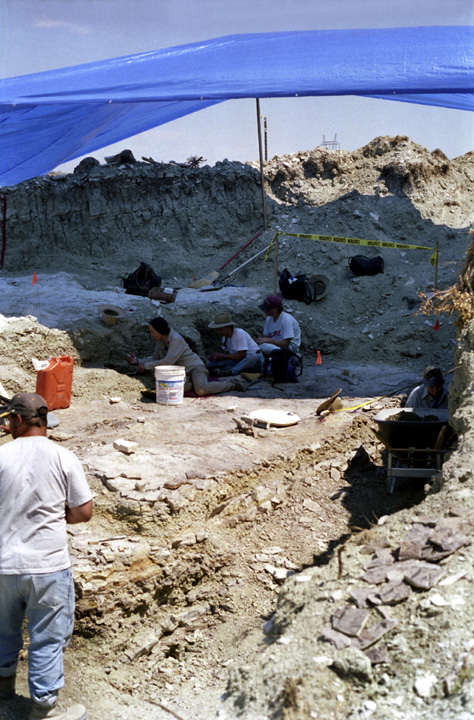 The recently discovered Swan Lake plant locality of Orellan age is the first good assemblage of plant material (leaves, trees, roots, grasses, pollen, and phytoliths) to be found in the upper (Oligocene) portion of the White River Formation. The lake deposits are lateral equivalents to the best mammal producing horizons a few miles away (up ancestral-North Platte drainage during Oligocene). Future detail studies of this plant data will proving the rate of climate change across the Eocene/Oligocene boundary in central North America. The phytoliths will eventually be used to show exactly which plants the various herbivores were eating. Dental plaque on ungulate teeth contain phytoliths identified in the plants of Swan Lake. Together the forensic science of "who is eating whom" and which herbivores are eating which plants will result in a true paleoecology of changes in the paleoenvironment from Eocene to the Oligocene within the White River Formation.
Breithaupt, B, 1997; North America's most complete Oligocene snakes. Tate Museum Publication #2, 1997 field conference guidebook, pp. 75-82.
Dickson, E D. III and Cunningham, C. R., 1997; Cranial Osteology of a new amphisbaenian from the Orellan of Wyoming. Tate Museum Publication #2, 1997 field conference guidebook, pp. 122-130.
Evanoff, E, 1993, Stratigraphy of the White River Formation Converse County, Wyoming [Ph.D. Thesis]: Boulder, University of Colorado, 298 p.
Evanoff, E., Prothero, D. R., and Lander, R. H., 1992, Eocene-Oligocene climatic change in North America: The White River Formation near Douglas, east-central Wyoming in Eocene-Oligocene climatic and biotic evolution, Princeton University Press, pp. 116-130.
Kron, D. G., 1978, Oligocene vertebrate paleontology of the Dilts Ranch area, Converse County, Wyoming [M. S. Thesis]: Laramie, University of Wyoming, 185 p.
Prothero, D. R., 1996, Magnetic stratigraphy of the White River Group in the High Plains, in The Terrestrial Eocene-Oligocene transition in North America, Prothero, D. R. and Emery, R. J. eds., Cambridge University Press, pp. 262-277.
Prothero, D. R., 1983, Magnetostratigraphy of the White River Group and its implications for Oligocene geochronology: Palaeogeography, Palaeoclimatology, Palaeoecology, v. 42, p. 151-166.
Prothero, D. R. and Swisher, C. C., 1992, Magnetostratigraphy and geochronology of the terrestrial Eocene-Oligocene transition in North America in Eocene-Oligocene climatic and biotic evolution, Princeton University Press, pp. 46-73.
Scott, J., 2000, High Precision U/Pb Geochronology of Oligocene Tuffs from the White River Formation, Douglas, Wyoming, SVP abstracts with programs, Journal of Vertebrate Paleontology, V.20 , No.3 , p.69A
Sundell, C. A., 1998; Orellan vertebrate burrows from Douglas, Wyoming: Their structure, inhabitants, and paleoecological implications, Journal of Vertebrate Paleontology, V. 18, No. 3, p. 81A.
Sundell, K. A., 1997a; Oreodonts: Extinct large burrowing mammals of the Oligocene. Tate Museum Publication #2, 1997 field conference guidebook, pp. 31-43.
Sundell, K. A., 1997b; Population statistics and preliminary biostratigraphy of an extensive vertebrate fauna from the White River Formation in Wyoming. Tate Museum Publication #2, 1997 field conference guidebook (abstract) p. 138.
Sundell, K. A., 1998; Hyaenodon: Nemesis of burrowing oreodonts, Journal of Vertebrate Paleontology, V. 18, No. 3, p. 81A.
Sundell, K. A., 1999; Taphonomy of a Multiple Poebrotherium kill site - an Archaeotherium meat cache, Journal of Vertebrate Paleontology, V. 19, No. 3, p. 79A.
Sundell, K. A., 2001; Preliminary Paleoecology of the Swan Lake Quarries: An Orellan plant, invertebrate, and vertebrate bearing lake deposit from the White River Formation, Converse County, Wyoming Journal of Vertebrate Paleontology, V. 21, No. 3, p. 106A.
Sundell, K, A, 2006, Burrowers of the Oligocene: Taphonomic Studies and Interpretation of the White River Underground in Tate 2006 Guidebook -Trackways and Trace Fossils, 12th annual symposium, pp. 73-77.
Swisher, C. C. and Prothero, D. R., 1990, Single-crystal 40Ar/39Ar dating of the Eocene- Oligocene transition in North America: Science, V. 249, p. 760-762.
Return to Douglas Fossils Main Page
home |